
Maybe you know you want to travel to South America, but the map still feels unclear.
Peru appears in almost every search. Colombia speaks of yagé and taitas. Ecuador offers ceremonies connected to several Amazonian peoples. Brazil includes both Indigenous traditions and organized religions with their own structures.
These are not different versions of one standard retreat.
They are different cultural settings, ceremonial forms, climates, travel experiences, and ways of understanding the medicine. Even within one country, two retreats can have very little in common.
The best place to begin is not with a list of the "top ten" retreats. It is with a clearer question:
What kind of tradition, setting, care, and responsibility are you looking for?
Camino al Sol publishes this guide and hosts yagé retreats in Colombia. That interest should be visible. Our intention here is to offer a framework you can use whether you eventually choose Colombia, Peru, Ecuador, Brazil, or somewhere else.
The short answer
There is no single best country for an ayahuasca retreat.
Colombia may suit someone drawn to yagé traditions and taitas, with the option of an accessible mountain setting. Peru offers a large and varied retreat landscape, including Shipibo-Konibo and mestizo traditions, jungle centers, Sacred Valley programs, and longer plant diets. Ecuador includes distinct Kichwa, Shuar, Achuar, and other Amazonian contexts. Brazil includes both Indigenous practices and structured religious movements such as Santo Daime and União do Vegetal.
Country is only the first filter.
A responsible decision also depends on who leads the ceremony, how they were trained, whether the retreat conducts meaningful medical and psychological screening, how many participants attend, what support is available, and what happens if something goes wrong.
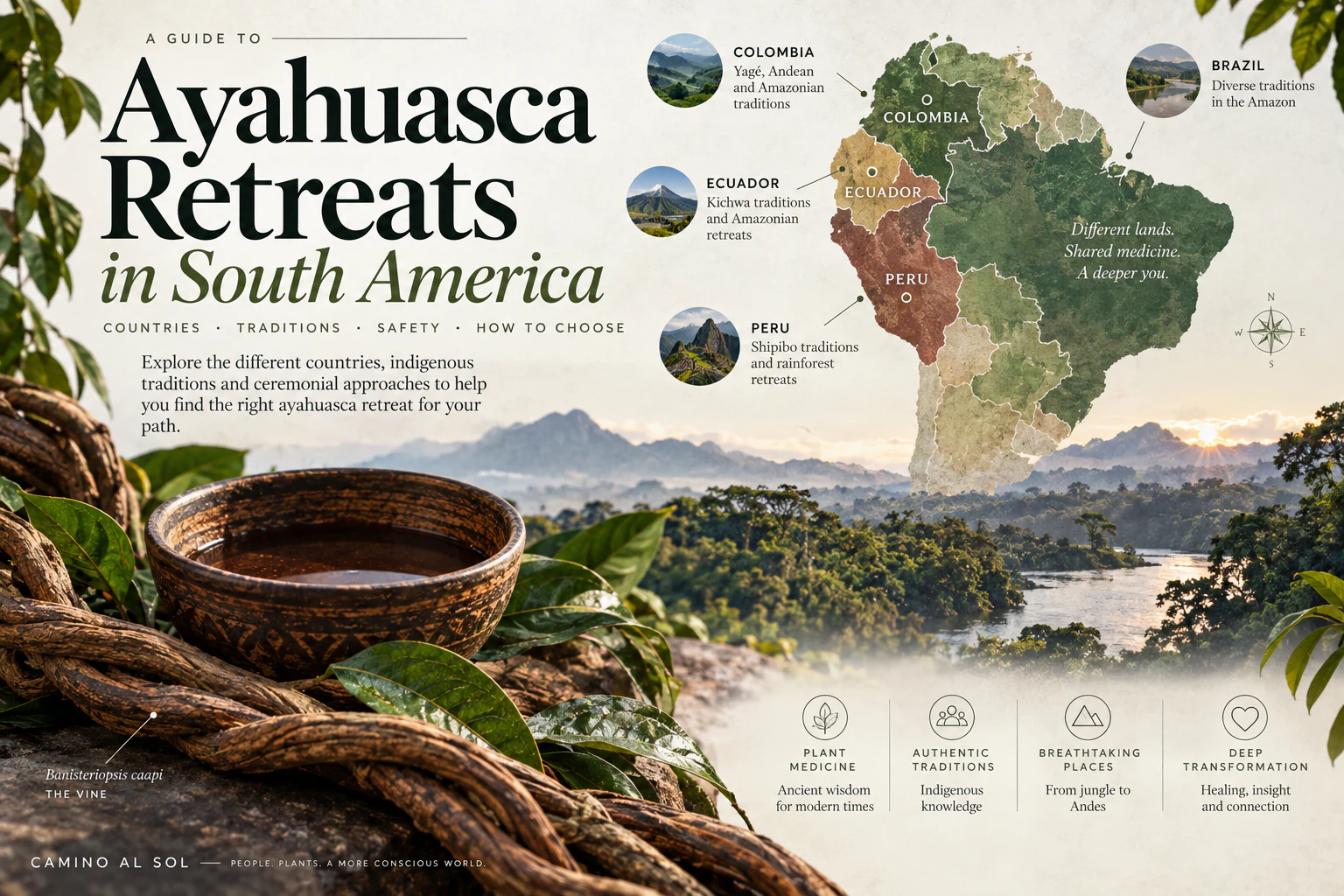
A regional overview of four countries and the distinct traditions a traveler may encounter.
Start with the tradition, not the marketing language
Words such as traditional, ancestral, and Indigenous-led appear on many retreat websites. They can be meaningful, but only when the retreat explains what they refer to.
Ask for specifics:
- Which people, community, family, or lineage does the ceremonial approach come from?
- Who leads the ceremony, and what title do they use within that tradition?
- How and for how long were they trained?
- Is the ceremonial leader present for the whole retreat?
- Does the community named by the retreat have an ongoing relationship with it?
- How are visiting practitioners compensated and represented?
- Which practices belong to the stated tradition, and which were added by the retreat?
A ceremonial form does not become more authentic because it is remote, uncomfortable, expensive, or described with spiritual language. Nor does an accessible retreat automatically lack depth.
Look for a relationship that can be explained, not a label designed to impress you.
| Country | Traditions and terms you may encounter | Common settings | Questions worth asking |
|---|---|---|---|
| Colombia | Yagé, taitas, Putumayo and other Colombian Amazonian traditions | Putumayo and Amazonian regions, travelling taita ceremonies, Andean mountain retreats | Which lineage does the taita represent? How is the tradition maintained outside its home territory? |
| Peru | Shipibo-Konibo, mestizo vegetalismo, icaros, plant diets | Iquitos, Ucayali, Loreto, Tarapoto, Sacred Valley, urban centers | Is this a retreat, a traditional diet, or a hybrid program? Who conducts the ceremonies and plant work? |
| Ecuador | Kichwa, Shuar, Achuar and other Amazonian traditions; natem in some Shuar contexts | Amazonian communities, jungle lodges, retreat centers near travel hubs | Which specific community and ceremonial practice is involved? Is the retreat community-led or using an Indigenous label? |
| Brazil | Diverse Indigenous traditions, Santo Daime, União do Vegetal, Barquinha and independent groups | Indigenous territories, churches, urban congregations, rural centers | Is this an Indigenous ceremony, a religious service, or a commercial retreat? What participation does the group expect? |
Colombia: yagé, taitas, and traditions carried from Putumayo
In Colombia, the medicine is commonly called yagé. The title Taita is used for a traditional doctor or elder in several Colombian yagé contexts, especially in the south of the country.
Putumayo is one of the regions most closely associated with Colombian yagé practice. The wider landscape includes distinct Indigenous peoples, families, teachers, and ceremonial approaches. It should not be reduced to one standardized "Colombian ceremony."
Colombian taitas have also travelled beyond traditional Amazonian territories for decades. ICEERS describes the development of itinerant taita ceremonies in Colombian cities since the 1970s. Today, yagé ceremonies may take place in Putumayo, near major cities, or in mountain retreat settings.
That difference in location matters.
An Amazonian retreat may involve heat, humidity, long ground travel, limited communications, and greater distance from a hospital. A retreat in the Andes near Medellín may have a cooler climate and simpler airport access. Neither setting is automatically deeper or safer. They simply create different practical conditions around the ceremony.
You can explore the terminology and cultural context further in our guide to yagé in Colombia.
"The important thing is where you are going to drink, and who you are going to drink with."
Taita Diego Marmolejo
One Colombian example: Camino al Sol
Camino al Sol holds retreats at Yaogará, a nature reserve in the mountains of Antioquia near Medellín. Ceremonies are led by Taita Diego Marmolejo, whose practice is rooted in the Putumayo yagé tradition.
The standard program is a multi-day retreat with three ceremonies, preparation time, medicine music, meals, accommodation, transport coordination from Medellín or the airport, and integration support. Groups are kept small, with the capacity stated on each retreat date.
Participation is not confirmed through instant booking. Applicants complete medical and psychological screening, including a review of health history, medications, contraindications, and personal circumstances. Dr. Marta Turpin serves as medical advisor and screening lead.
This does not make Camino al Sol the right choice for everyone. Someone seeking a long jungle diet, a Shipibo-Konibo ceremonial context, or a Brazilian religious community is looking for something different. For readers specifically comparing Colombian options, the Colombia retreat guide explains the local decision in more detail.
Peru: Shipibo-Konibo practice, icaros, and plant diets
Peru has one of the largest and most visible retreat landscapes in South America. But "a retreat in Peru" could mean a jungle lodge outside Iquitos, a Shipibo-Konibo-led program near Pucallpa, a mestizo vegetalismo center, a retreat in the Sacred Valley, or a longer plant diet.
These are not interchangeable.
Shipibo-Konibo ceremonial practice is often associated with sacred songs commonly called icaros, or rao bewá in Shipibo contexts, and with knowledge developed through relationships with medicinal plants. Peru's Ministry of Culture has recognized both the traditional knowledge and use of ayahuasca and the icaros of the Shipibo-Konibo-Xetebo people as national cultural heritage.
A plant diet is also more than a short list of foods to avoid before ceremony. In traditional and adapted Amazonian contexts, it may involve isolation, behavioral and dietary restrictions, work with a particular plant, and guidance from an experienced practitioner. A retreat that offers three ceremonies and light dietary preparation is not necessarily offering the same thing as a supervised traditional diet.
Ask the center which form it provides.
Location also changes the experience. Iquitos and parts of Loreto can involve intense heat, river transport, insects, and considerable distance from emergency care. Ucayali has strong Shipibo-Konibo cultural presence. Sacred Valley retreats may be cooler and easier to combine with other travel, but the ceremonial practitioners may come from another region.
Do not assume that being in Peru proves a retreat is Shipibo-led, Indigenous-led, well screened, or safe. Verify those points individually. Our Peru and Colombia comparison covers the practical destination tradeoffs in more detail.
Ecuador: ask which community and which practice
Ecuador's Amazon is home to several peoples with their own relationships to ayahuasca and other teacher plants. Retreat descriptions may refer to Kichwa, Shuar, Achuar, Cofán, Secoya, or other traditions.
The specific name matters.
For example, academic descriptions of Shuar practice use the term natem for ayahuasca and uwishin for a ceremonial specialist. That does not make those terms universal across Ecuador. Kichwa communities, practitioners working in mixed settings, and internationally oriented retreat centers may use different language and structures.
Research from Ecuador has documented the continuing role of natem within a Shuar community in Zamora-Chinchipe. Still, a country-level description cannot tell you how one retreat operates.
Ask:
- Which community does the ceremonial leader belong to?
- Does the retreat take place within that community or at an outside center?
- Who owns and manages the retreat?
- How are cultural knowledge and income shared?
- Is translation available throughout the ceremony and preparation?
- What emergency access exists from the location?
A remote Amazonian setting can offer closeness to the landscape and community from which a practice comes. It can also mean more difficult transport, fewer nearby medical resources, and language barriers. Those tradeoffs should be explained before payment, not discovered after arrival.
Brazil: Indigenous practices and organized religions are different paths
Brazil cannot be described through one ceremonial model.
Ayahuasca is used within diverse Indigenous traditions. It also has an established place within syncretic religious movements, including Santo Daime, União do Vegetal, and Barquinha. These religions developed distinct teachings, music, leadership structures, clothing, and expectations of participants.
A Santo Daime work or União do Vegetal session is not simply a retreat ceremony with Brazilian music. It takes place within a religious framework. There may be hymns, uniforms, formal seating or movement, doctrinal teachings, and an ongoing congregational life.
Brazil's national drug-policy council has issued specific guidance governing the religious use of ayahuasca. That recognition should not be interpreted as blanket approval of every commercial retreat or independent ceremony in the country.
Before choosing a Brazilian option, establish which context you are entering:
- an Indigenous ceremony connected to a named people;
- an established religious congregation;
- an independent spiritual group;
- or a commercial residential retreat.
Then ask what participation means. Someone seeking a short retreat with private accommodation and integration calls may not be looking for congregational religious practice. Someone drawn to a sustained spiritual community may find that a church setting offers something a commercial retreat does not.
The country is not the retreat
Country comparisons are useful for climate, travel, language, and broad cultural orientation. They are weak predictors of how one particular retreat will care for you.
Use the following questions to compare actual programs.
| Consideration | What to ask | A concerning answer |
|---|---|---|
| Ceremonial leadership | Who leads every ceremony, and what is their training and relationship to the tradition? | "Our shamans rotate" without names or biographies |
| Group size | What is the maximum number of participants, and how many support staff are present? | No stated limit or one leader responsible for a large group |
| Screening | Who reviews medical and psychological information, and when does that happen? | Payment first, health questions later |
| Emergency planning | What happens during a medical or psychological emergency? | "The medicine always knows what to do" |
| Ingredients | What plants or other substances may be served? | Unclear ingredients or surprise additions |
| Preparation | What guidance and personal contact are provided before arrival? | Only a generic diet PDF |
| Integration | What support is available after the retreat, by whom, and for how long? | Integration used as a marketing word without a defined service |
| Consent | What are the policies on touch, privacy, photography, and sexual boundaries? | No written policy or dismissive answers |
| Accommodation | Are rooms private or shared? Are bathrooms, water, electricity, and accessibility described accurately? | Carefully framed photographs but no practical details |
| Cost | What is included, excluded, refundable, or due later? | Pressure to send a deposit before questions are answered |
| Language | Can you communicate directly with the ceremonial and support teams? | Translation available only during sales calls |
Jungle or mountains?
Setting changes more than the view.
A deep jungle retreat may involve river or unpaved-road transport, humidity, insects, limited phone coverage, basic accommodation, and a long transfer to medical care. For some people, that closeness to the Amazonian environment is central to why they go.
A mountain retreat may offer cooler nights, road access, and easier international travel. It may also take place far from the original territory of the tradition being practiced. Ask how the ceremonial leaders maintain their cultural relationship and authority in that setting.
Neither hardship nor comfort proves spiritual depth.
Consider your mobility, heat tolerance, sleep needs, dietary requirements, travel experience, and how your body responds to altitude or long transfers. If a retreat treats practical questions as signs that you are not "surrendering," slow down.
A responsible center should want you to understand where you are going.
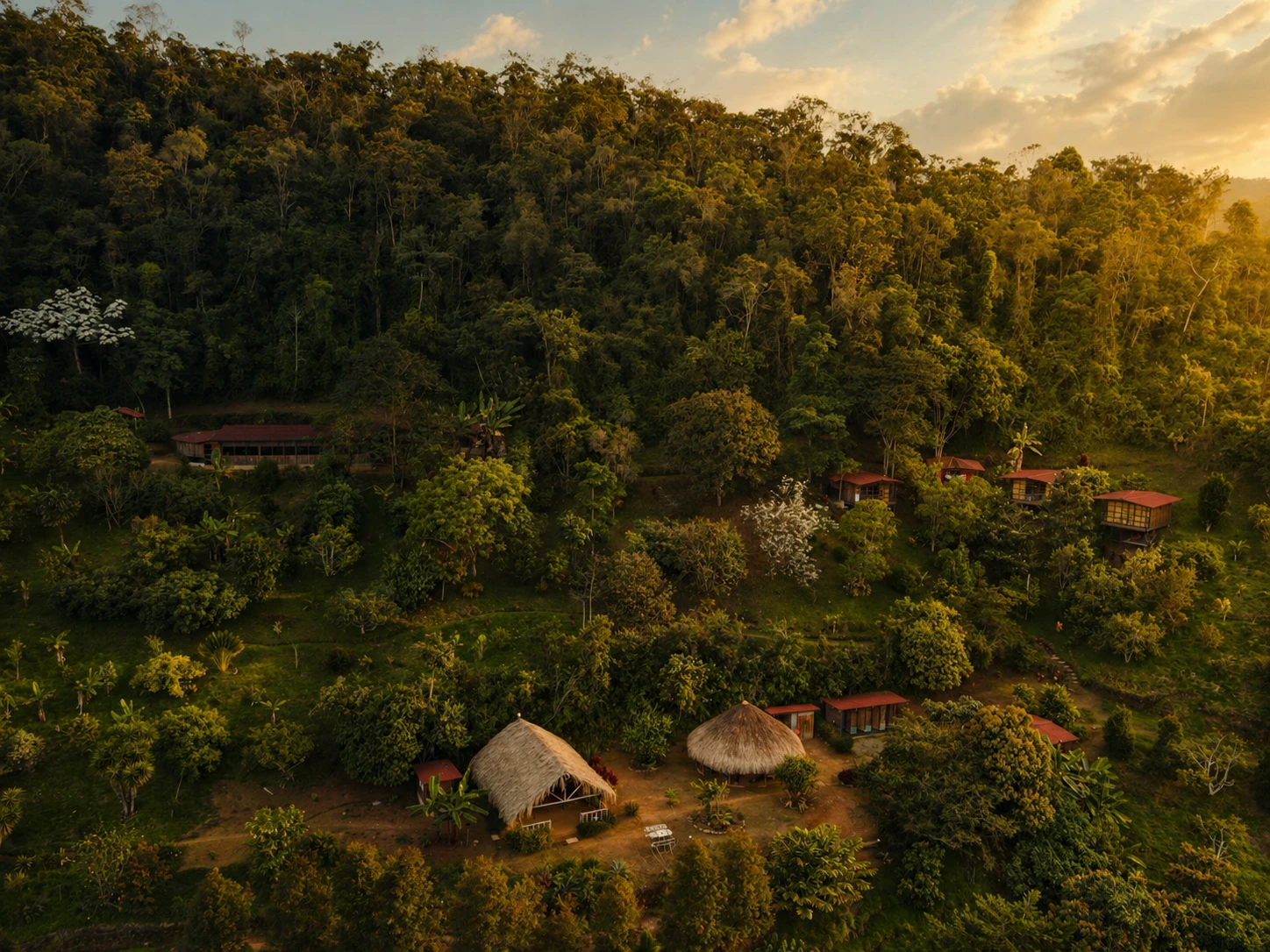
An Andean mountain retreat offers different conditions from a remote Amazonian lodge.
How long should an ayahuasca retreat be?
There is no correct number of days or ceremonies for everyone.
A single ceremony provides little time to know the team, recover, or receive support if the experience is difficult. A short multi-day retreat may be more accessible, but its schedule should include rest rather than compressing multiple intense practices together. A longer retreat allows more time, yet more ceremonies do not automatically produce a better result.
Extended plant diets are a different commitment again. They may involve weeks or months of restrictions and close supervision. They should not be presented as a stronger version of an ordinary retreat.
Ask for the full daily schedule. Look for adequate sleep, rest between ceremonies, unstructured time, and a clear explanation of any additional practices or substances.
More is not always deeper.
Safety begins before you travel
Beautiful accommodation and moving testimonials cannot tell you whether a retreat is prepared to care for you.
Screening can.
A responsible process should ask about current and past medications, supplements, heart and blood-pressure conditions, seizures, pregnancy, substance use, mental-health history, recent crises, and personal or family history of psychosis or mania. Answers that raise concern should lead to a real conversation, not an automated approval.
Ayahuasca contains harmala alkaloids that affect monoamine oxidase. This is one reason antidepressants, MAOIs, stimulants, some other medications, supplements, and substances require individualized review. A systematic review of adverse events and toxicity also identifies psychiatric history, family history of psychosis, cardiovascular factors, and concurrent substance use as relevant areas of concern.
Never stop or change prescribed medication simply to meet a retreat date. A retreat should not instruct you to do so without involvement from a qualified medical professional.
Screening is only the beginning. Ask about:
- sober and available support staff during ceremony;
- first-aid capability and emergency equipment;
- the route and transport time to appropriate medical care;
- who makes the decision to call emergency services;
- overnight monitoring and support;
- procedures for panic, confusion, wandering, aggression, or prolonged distress;
- safeguarding and sexual-boundary policies;
- documentation of informed consent;
- and what ingredients are served.
Research into publicly advertised psychedelic retreats found substantial variation in reported safety practices. ICEERS also provides AyaSafe screening and emergency-planning resources for participants and facilitators. A retreat does not need to use those exact documents, but it should be able to answer the same practical questions.
For a closer look at contraindications and risk assessment, read our ayahuasca safety guide.
This page is educational and does not replace medical advice. Do not stop or change medication without speaking with a qualified medical professional.
If you are in crisis, experiencing suicidal thoughts, psychosis, chest pain, severe withdrawal, or another urgent medical issue, seek emergency care immediately.
Traditional knowledge and clinical competence are not the same thing
A traditional ceremonial leader may have decades of knowledge about yagé, song, plants, prayer, and care within their culture.
That does not automatically make them a physician, psychiatrist, emergency responder, or medication specialist.
The reverse is also true. A doctor may understand cardiovascular risk or drug interactions without knowing how to hold a traditional ceremony.
A well-supported retreat should understand this distinction. It should name who is responsible for ceremonial leadership, screening, general participant care, emergency response, translation, and integration. One person does not need to hold every role, but every role should have an owner.
Be cautious when ceremonial experience is presented as proof of medical competence, or when a clinical title is used to make ceremonial claims sound scientifically proven.
Preparation and integration are part of the retreat
Preparation is not just avoiding certain foods.
It should help you understand the schedule, the tradition, physical effects, emotional uncertainty, medications and contraindications, consent policies, travel, and what support will be available. You should know what you are agreeing to before you arrive.
Integration should be equally concrete. Ask whether it includes group conversations, individual calls, written guidance, professional referrals, or ongoing access to the team. Ask who provides it and what happens if you are still distressed after returning home.
The ceremony is not the finished result.
How you sleep, relate, work, make decisions, and seek support afterward matters more than how dramatic the night felt. Our integration guide explains what that process can look like without treating every difficult experience as a spiritual breakthrough.
Cost is about what surrounds the ceremony
A lower price is not proof of poor care. A high price is not proof of safety, cultural depth, or ethical practice.
Compare the whole cost:
- accommodation and room type;
- meals and dietary needs;
- airport or city transfers;
- number of ceremonies;
- preparation and integration support;
- private consultations;
- translation;
- additional practices or treatments;
- deposits and payment deadlines;
- cancellation and refund terms;
- flights, hotels, insurance, and onward travel;
- and emergency transport if it becomes necessary.
Ask for these details in writing.
Also ask where the money goes. If a retreat prominently markets an Indigenous lineage, it should be able to explain the working relationship with the practitioners and communities whose names it uses.
A 20-minute way to compare your shortlist
Choose no more than three retreats at first. Then complete this process for each one:
- Write down the exact tradition and the name of the ceremonial leader.
- Find the maximum group size and number of support staff.
- Read the screening form before paying anything.
- Ask for the emergency plan and approximate transfer time to medical care.
- List every included and excluded cost.
- Check the cancellation policy.
- Ask what preparation and integration actually include.
- Read critical reviews as well as positive ones.
- Arrange a conversation with the team if important answers remain unclear.
- Notice whether your questions are welcomed or treated as a lack of trust.
You are not looking for a retreat that promises certainty.
You are looking for one that responds to uncertainty with honesty, preparation, and care.
Choose the people and the container
The country matters. Tradition matters. Setting matters.
But none of them can replace careful investigation of the people who will be responsible for you.
Choose slowly. Ask direct questions. Let a retreat show you how it handles boundaries, health information, money, cultural claims, and uncertainty before you decide how beautiful its ceremony space looks.
If Colombia's yagé tradition and an accessible mountain setting fit what you are seeking, you can review the current Camino al Sol retreats near Medellín. Compare the same questions in this guide against what we publish, and ask us about anything that remains unclear.
The right next step is not always an application.
Sometimes it is one more honest question.
