
If you are asking this question, that is already a good sign.
Ayahuasca is not something to approach casually. In Colombia, we often speak of yagé — the traditional name used in many Colombian lineages. It can be powerful, beautiful, difficult, and deeply confronting. But it is not right for everyone.
Some people should not drink ayahuasca at all. Some should not drink right now. Others may be able to participate, but only after careful medical and psychological screening.
This page is here to help you understand the difference.
This page is educational and does not replace medical advice. Do not stop or change medication without speaking with a qualified medical professional.
If you are in crisis, experiencing suicidal thoughts, psychosis, chest pain, severe withdrawal, or another urgent medical issue, seek emergency care immediately.
The difference between “not now” and “not ever”
Not every safety concern means the same thing.
Some contraindications are absolute. That means ayahuasca is not appropriate because the risk is too high. This may include certain psychiatric histories, dangerous medication interactions, pregnancy, serious cardiovascular conditions, or active medical instability.
Other contraindications are relative. That means the situation needs careful review. A person with mild anxiety, stable depression, past trauma, or a well-managed health condition may not be automatically excluded, but they should never assume ayahuasca is safe without screening.
There is also a third category: not now.
This matters.
Someone may not be permanently excluded, but if they are in active crisis, withdrawing from medication, recently hospitalized, or without stable support, the responsible answer may be to wait.
For a broader overview, read our guide to the main risks of ayahuasca. If your concern is whether the medicine can become seriously unsafe in the wrong context, read more about how dangerous ayahuasca can be.
Psychiatric history — what disqualifies and what needs review
Mental health is one of the most important areas of screening.
Ayahuasca can bring strong emotional, sensory, and psychological material to the surface. For some people, that may be meaningful. For others, it may be destabilizing.
People with a personal history of psychosis, schizophrenia, schizoaffective disorder, delusions, hallucinations outside ceremony, or manic episodes should generally avoid ayahuasca. A history of bipolar I disorder, especially with mania or psychotic features, is also a major red flag.
This is not judgment.
It is protection.
A ceremony can intensify perception and emotion. If someone already has difficulty distinguishing inner experience from outer reality, ayahuasca may increase risk rather than support healing.
Severe dissociation, unstable identity states, active paranoia, or a recent psychiatric hospitalization also require very careful review. In many cases, the answer may be no, or not now.
Anxiety and depression are more nuanced. A diagnosis does not automatically mean someone is excluded. But severity matters. Stability matters. Medication matters. Support after the retreat matters.
If anxiety is your main concern, read more about whether ayahuasca is safe for anxiety. If you are exploring mood symptoms, read our page on ayahuasca and depression. If you are wondering whether ayahuasca may support anxiety work in some cases, we also have a separate page on whether ayahuasca can help with anxiety.
Medications — the risk that must be discussed first
Medication is one of the clearest reasons ayahuasca requires screening.
Ayahuasca contains compounds that affect monoamine oxidase activity. That is part of what allows the medicine to work orally. It is also part of why interactions with certain medications can be serious.
The highest concern is usually serotonergic medication. This includes many antidepressants, especially SSRIs, SNRIs, MAOIs, some tricyclics, certain migraine medications, MDMA, some stimulants, and other substances that affect serotonin.
Combining these with ayahuasca may increase the risk of serotonin toxicity, which can become a medical emergency.
Lithium is also a major concern with psychedelics and should be disclosed clearly. Antipsychotics, mood stabilizers, benzodiazepines, stimulants, blood pressure medication, seizure medication, sleep medication, and many other prescriptions may affect safety, stability, or the ceremony itself.
Do not hide medication use.
Do not stop medication on your own.
Do not reduce your dose just to attend a retreat.
If you take psychiatric medication, blood pressure medication, seizure medication, or any prescription that affects mood, sleep, heart rhythm, blood pressure, or the nervous system, it needs to be reviewed before acceptance.
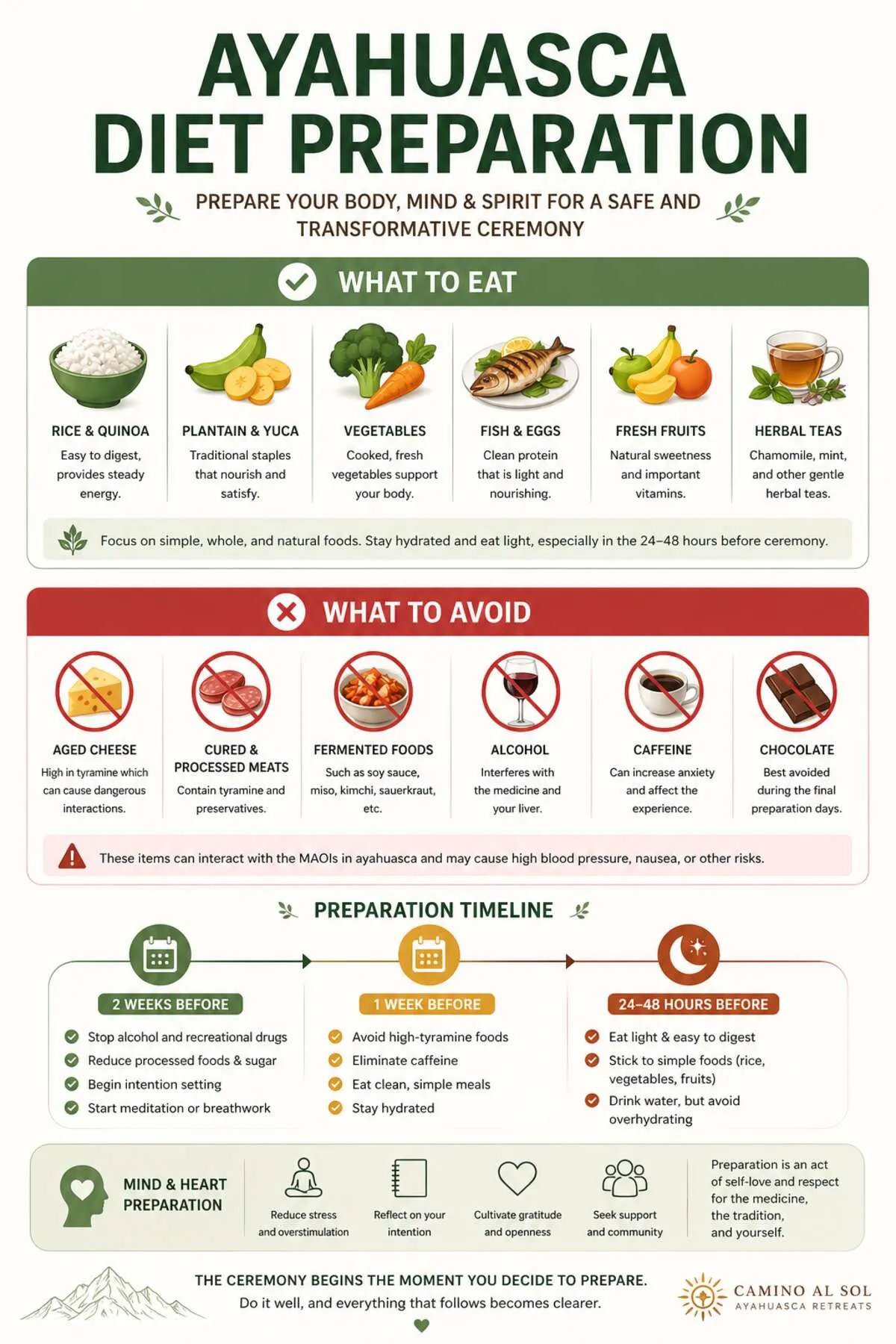
For more detail, read our page on ayahuasca safety and SSRIs. For preparation expectations, including what may need review before ceremony, see our ayahuasca diet and preparation guide.
Physical health — heart, blood pressure, liver, pregnancy, and seizures
Ayahuasca is not only psychological. It affects the body.
People with serious heart disease, uncontrolled high blood pressure, arrhythmias, a history of stroke, recent heart attack, or significant cardiovascular instability should not assume ayahuasca is appropriate. The ceremony can involve vomiting, emotional intensity, changes in blood pressure, long hours awake, and physical stress.
Seizure history also requires careful review. Some people may be excluded depending on the type, frequency, medication status, and stability of the condition.
Liver disease is another important concern because the body must process the medicine and any other substances involved. Kidney disease, severe metabolic disorders, uncontrolled diabetes, serious respiratory illness, and complex chronic illness should also be disclosed.
Pregnancy is generally treated as a contraindication. Breastfeeding also requires caution and should be reviewed with a qualified medical professional. If you are pregnant, trying to become pregnant, breastfeeding, or unsure, do not treat ceremony as something to “see how it feels.”
For a broader discussion of women’s considerations, including pregnancy and cycle-related questions, read our page on ayahuasca safety for women.
Situational factors — when life is too unstable for ceremony
Sometimes the contraindication is not a diagnosis.
It is timing.
Ayahuasca can open deep emotional material. If your life is already unstable, that opening may be too much.
You may need to wait if you are in an active mental health crisis, experiencing suicidal thoughts, recently hospitalized, newly sober without support, actively withdrawing from substances, in the middle of a traumatic event, or without safe housing or emotional support after the retreat.
Recent grief, relationship rupture, burnout, or trauma does not always exclude someone. But the question is whether there is enough stability to hold what the medicine may bring.
The medicine is not an escape from life.
It asks you to meet life more honestly.
For people coming for the first time, this can be especially important. Read more about safety for first-time users if you are unsure whether your nervous system, expectations, or support structure are ready.
Trauma and dissociation need special care
Many people feel called to ayahuasca because of trauma.
That does not make the call wrong. But trauma work requires care, pacing, and support. A ceremony can bring memories, body sensations, fear, grief, anger, or fragmented emotional material into awareness. For some, this may become part of healing. For others, it may overwhelm the system.
The key question is not only “Do I have trauma?”
The better question is: “How stable am I with what the trauma brings up?”
If you have severe dissociation, frequent flashbacks, self-harm risk, active suicidality, recent abuse, or no support after the retreat, ayahuasca may not be appropriate right now.
If your trauma history is present but you have stability, support, and honest screening, the answer may be different.
Read more about ayahuasca and trauma. If you are exploring the possible role of ayahuasca in trauma work more broadly, see our page on whether ayahuasca can help with PTSD.
Relative contraindications — when the answer is “screen first”
Some conditions do not automatically mean no.
They mean slow down.
Relative contraindications may include mild or moderate anxiety, stable depression, past trauma with good support, controlled blood pressure, remote seizure history, previous panic attacks, long-term recovery from addiction, or a history of difficult psychedelic experiences.
These are not simple yes-or-no categories.
A person with mild anxiety and strong support may be a possible candidate. A person with severe panic, unstable medication use, and no aftercare may not be.
A person with past depression may be considered. A person with active suicidality or recent hospitalization should seek immediate professional support, not a ceremony.
A person with trauma may be ready. A person in acute trauma response may need stabilization first.
This is why honest screening matters more than confidence.
Confidence can lie. Screening asks better questions.
How to find out if you specifically are a candidate
At Camino al Sol, every applicant goes through medical and psychological review before acceptance. We hold small, carefully screened groups in the mountains of Antioquia, near Medellín, Colombia.
There is no instant booking.
That is intentional.
Our role is not to convince everyone to drink yagé. Our role is to protect the circle, the individual, and the integrity of the medicine.
As Taita Diego says:
“The important thing is where you are going to drink, and who you are going to drink with.”
Where includes the land, the tradition, the preparation, and the people holding the space.
Who includes the Taita, the team, the medical screening, the integration support, and the honesty of the person applying.
If you are unsure, start with our screening approach. If you feel called and want your situation reviewed, you can apply for screening.
The right answer may be yes.
It may be not now.
It may be no.
All three can be responsible.
