
Snakes and serpents are among the most commonly reported animals in ayahuasca visions. They may evoke transformation, medicine, fear, protection, sexuality, danger, power or renewal, but there is no universal snake ayahuasca meaning. The details matter more than a generic symbol definition: What was the snake doing? How did you feel? What happened immediately before and afterward? What relationship do you already have with snakes? And perhaps most importantly, what relevance does the experience still have once the ceremony is over? This is where a simple framework from our broader guide to ayahuasca symbols and visions becomes useful: Observation: What actually happened? Interpretation: What do you think it meant? Integration: What relevance, if any, does that interpretation have to your life afterward? Keeping those three stages separate can prevent a powerful image from turning too quickly into a fixed story.
Why Are Snakes So Common in Ayahuasca Visions?
The connection between snakes and ayahuasca isn't just an internet spirituality trope. Cognitive psychologist Benny Shanon conducted one of the most extensive attempts to document the phenomenology of ayahuasca experiences. His work drew on his own experiences and interviews with Indigenous people, shamans, members of ayahuasca religions and other participants. In an earlier paper on recurring visionary content, Shanon described serpents among the most salient images reported across people from different cultural and personal backgrounds, alongside large cats, birds and palaces. That doesn't tell us why snakes appear so often. It does establish something more modest and useful: serpent imagery really does recur in ayahuasca experiences. There are several possible layers worth considering. Snakes are biologically distinctive animals that can evoke strong reactions before psychedelics enter the picture. Humans encounter them in stories about danger, medicine, sexuality, death, renewal, knowledge and power. A participant may therefore arrive with an enormous reservoir of cultural and personal associations already attached to the animal. Ayahuasca also produces complex changes in visual perception, imagery, emotion, bodily awareness and cognition. Science has investigated these altered states, but there is no established neurological explanation that tells us why a particular person sees a particular snake on a particular night. So "people often see snakes" and "we know what those snakes mean" are two very different claims.
Does a Snake Vision Mean Transformation?
Transformation is probably the most common answer you'll find online. The association isn't difficult to understand. A snake sheds its skin. That makes it an unusually vivid metaphor for leaving something behind, renewal, transition, death and rebirth. If you encountered a snake while moving through a major change in your life, that metaphor may feel remarkably appropriate. But transformation is an interpretation, not a decoding rule. Imagine five people see essentially the same image: a large snake approaching them. One has feared snakes since childhood and experiences terror. Another grew up around snakes and feels calm. Another experiences the serpent as intensely sexual. Another feels watched and protected. Another has been thinking about leaving a relationship and immediately associates the shedding snake with change. The image is similar. The experience isn't. A snake can plausibly evoke:
- fear or danger
- sexuality
- bodily vulnerability
- power
- medicine
- protection
- instinct
- a personal memory
- a cultural or religious association
- transformation or renewal
The useful question isn't simply, "What do snakes symbolize?" It is, "What was happening between me and this snake?"

Snakes in Colombian and Amazonian Yagé Traditions
This subject needs more precision than it usually receives online. There isn't one "Indigenous meaning of the snake." Amazonia contains many peoples, languages, cosmologies and ceremonial traditions. Colombian yagé traditions also developed within particular cultural lineages rather than a single system called "shamanism." One especially relevant example comes from the Desana of the Colombian northwest Amazon. Writing about yagé traditions and mythology, Colombian anthropological sources describe a Desana origin narrative in which the arrival of yagé is accompanied by extraordinary colors and images, including forms appearing as small serpents. The vine itself participates in a much larger cosmological story connecting people, knowledge, language and different dimensions of existence. That is a specific tradition. It shouldn't automatically be converted into a universal interpretation of your snake vision. Colombian ethnographic writing on Inga and Kamsá yagé practices offers another useful insight. Visionary experience can be understood through the participant's personal and cultural world. In other words, the imagery doesn't arrive in a cultural vacuum. That distinction matters. A Desana narrative, an interpretation from a Putumayo Taita, a Western participant's childhood fear of snakes and a modern internet article about "serpent energy" aren't interchangeable sources. At Camino al Sol, our own context is traditional Colombian yagé. That makes cultural lineage important, but it doesn't give us a universal dictionary for somebody else's visions.
When the Snake Feels Frightening
Some snake visions are terrifying. A participant may feel chased, bitten, surrounded, constricted, swallowed or attacked. A serpent can appear enormous or predatory. Sometimes fear becomes the dominant feature of the entire experience. It's tempting afterward to turn this into a reassuring story: "The fear was actually healing." Maybe the experience eventually becomes meaningful. But fear doesn't need to be renamed before you understand it. Start with what happened. Ask:
- What exactly did the snake do?
- What did I expect it to do?
- Did it actually attack me?
- What happened immediately before it appeared?
- Where did I feel the fear in my body?
- Did the snake change as the experience continued?
- Did my relationship with it change?
- Does this fear resemble anything familiar in ordinary life?
That distinction between what happened and what you feared would happen can be particularly revealing. For example:
Observation: A snake moved toward me and I became terrified that it would bite me.
Interpretation: It was attacking me.
Further inquiry: Did it actually attack, or did I experience its approach as an attack?
Those aren't the same experience. If a frightening ceremony continues to disturb you afterward, integration matters more than finding a comforting symbolic explanation. Our integration guidance explains how we approach the period after ceremony.
When the Snake Feels Protective or Healing
The opposite experience also occurs. Someone may feel a serpent surrounding the body without fear, watching them, guiding them, moving through their visual field or appearing during an experience they understand as cleansing or medicinal. The wording here matters. A participant can accurately say: "I experienced the snake as healing." That's different from saying: "The snake healed me." The first describes the person's experience. The second makes a claim about what objectively happened. If a serpent felt protective, medicinal or benevolent, explore that relationship rather than immediately turning it into doctrine. What made it feel safe? Was it the snake's behavior? Its movement? The emotional atmosphere? Something communicated during the experience? Did fear disappear when it arrived, or did calm gradually develop? Sometimes the emotional relationship to an image tells you more than the image itself.
What Does a Snake Bite Mean in an Ayahuasca Vision?
A snake bite is one of the most dramatic serpent experiences someone can have during ayahuasca. Online interpretations may describe it as initiation, awakening, confrontation, transformation, poisoning, healing or the sudden arrival of knowledge. Any of those might become meaningful metaphors for a particular person. None should be assumed. Separate the event into pieces. Where were you bitten? What did you feel immediately afterward? Were you frightened of dying? Did the experience continue normally? Did the snake seem hostile? Did the bite change you in the vision? Were strong physical sensations already occurring? A visionary bite may also overlap with bodily sensations during ceremony. Ayahuasca experiences can include intense changes in bodily awareness, and the mind may represent sensation through imagery. That doesn't mean every visionary bite is "just physical," either. It means you don't have to choose an explanation before you've examined the experience.
What Does Becoming a Snake Mean?
Seeing a snake and being a snake are phenomenologically different experiences. Some altered-state experiences involve dramatic changes in identity or bodily form. A person may feel animal-like, experience their body differently, move differently in imagination or temporarily lose the ordinary boundary between "me" and what they're perceiving. If you became a serpent, asking what snakes symbolize may actually be less useful than asking: What was it like to be one? Were you moving close to the earth? Were you powerful or vulnerable? Did you feel more instinctive? Was there sexuality? Did your human identity disappear? Did the transformation feel chosen, imposed, frightening or completely natural? The experience may intersect with altered embodiment or a loosening of the ordinary sense of self. But again, "becoming a snake means X" would throw away most of the information.
Giant Serpents and Anacondas
Scale changes an experience. A small snake at your feet and an immense anaconda filling the entire visual field may both belong to the category "snake," but psychologically they can feel completely different. Large serpents and anacondas also carry substantial cultural weight in parts of Amazonia. Serpent motifs appear across Amazonian mythologies, but their roles differ between peoples and stories. That makes specificity essential. If you see an enormous serpent during ayahuasca, it's reasonable to explore Amazonian cultural parallels. It isn't reasonable to take one group's cosmology and declare that your anaconda "therefore means" the same thing. Instead, first ask what its size did to the experience. Did you feel insignificant? Protected? Overpowered? Awe? Fear? Did the serpent contain you, threaten you or simply exist at a scale that made normal human proportions disappear? Sometimes enormity itself is part of the experience.
Multiple Snakes or Recurring Snake Visions
Seeing snakes repeatedly can make the imagery harder to dismiss. Perhaps serpents appear throughout one ceremony. Perhaps they return during several ceremonies months apart. Perhaps the same snake appears repeatedly. Repetition makes a symbol worth examining. It doesn't automatically prove an external message. Repeated imagery could relate to a personally important theme, expectations created by previous ceremonies, recurring emotions, cultural exposure, unresolved material, or something the participant understands spiritually. The most useful approach is comparison. Keep notes after each experience:
| Question | Ceremony 1 | Ceremony 2 | Ceremony 3 |
|---|---|---|---|
| What did the snake look like? | |||
| What was it doing? | |||
| How did I feel? | |||
| What happened before it appeared? | |||
| What happened afterward? | |||
| What did I think it meant at the time? | |||
| What do I think now? | |||
| Patterns may become visible that weren't obvious inside any single ceremony. |
Snake Visions and the Body
Snake experiences aren't always purely visual. Someone may feel something moving through the body, wrapping around the torso, travelling along the spine, pressing against the chest or moving through the abdomen. Those sensations can occur alongside nausea, purging, shaking, temperature changes or other intense aspects of ceremony. This is an area where symbolic certainty becomes particularly risky. A participant might describe a sensation as energy, a serpent, cleansing or medicine. Those descriptions may accurately communicate how the experience felt. They shouldn't automatically be turned into medical explanations. A useful integration question is: What did I physically experience before deciding what the sensation was? For example: Observation: "I felt a wave-like movement from my stomach toward my chest." Interpretation: "A snake was moving through me." Later meaning: "I experienced it as releasing something I'd been holding." Keeping those levels separate doesn't make the experience less meaningful. It makes your description more precise.
Snake Visions vs Snake Dreams
People searching for the spiritual meaning of snakes in dreams encounter many of the same interpretations: transformation, rebirth, sexuality, danger, intuition, healing and awakening. The same caution applies. A snake dream spiritual meaning isn't determined by the animal alone. The snake's behavior, your emotional response, your personal history and the wider context of the dream all matter. This doesn't mean dreams and ayahuasca visions are neurologically identical. They aren't interchangeable states, and we shouldn't pretend they are. What they share is an interpretation problem: A vivid image can feel meaningful before you actually know what it means. Whether you dreamed about a snake last night or encountered one during yagé, a symbol dictionary can provide possible associations. It can't know your life.
A Better Way to Interpret a Snake Vision
Instead of beginning with "snake = transformation," try this process.
1. Describe the snake without interpreting it
Size, color, movement, location, number and physical relationship to you.
2. Record what it actually did
Separate its behavior from what you expected or feared it might do.
3. Identify your strongest emotion
Fear? Awe? Calm? Disgust? Attraction? Curiosity? Love? Nothing at all?
4. Consider your existing relationship with snakes
Childhood encounters, phobias, religious imagery, books, films, previous ceremonies and cultural associations can all matter.
5. Reconstruct what happened immediately before and after
Visionary images exist within sequences. Context can change interpretation substantially.
6. Notice whether the snake changed
Did an attacker become protective? Did a small snake become enormous? Did you become the snake?
7. Compare recurring appearances
If serpents return, compare the experiences rather than interpreting each one independently.
8. Consider cultural interpretations carefully
Traditions can offer valuable perspectives. Name the tradition rather than combining Indigenous, Christian, Hindu, psychoanalytic and modern spiritual symbolism into one supposed universal teaching.
9. Discuss it during integration
Another person can help you notice assumptions without claiming to possess the answer.
10. Give the interpretation time
An explanation that feels certain the morning after ceremony may feel completely different one week or six months later.
A worked example
Suppose your memory is: "A large black snake wrapped around my chest." Your immediate interpretation might be: "It was removing negative energy." Instead of rejecting that interpretation or accepting it as fact, investigate it.
- Did I feel trapped or protected?
- Was there pain?
- What happened immediately beforehand?
- What does black mean to me personally?
- Was I already experiencing pressure in my chest?
- Did my breathing change?
- What did the snake do next?
- Did it eventually leave?
- Why did I interpret the experience as removing something?
- Does that explanation still feel useful a week later?
The goal isn't to strip the experience of mystery. It's to avoid replacing mystery with certainty too quickly.

Should You Google "Snake Spiritual Meaning" After Ayahuasca?
You can. Just understand what you're getting. Search for snake spiritual meaning and you'll repeatedly encounter:
- transformation
- rebirth
- healing
- sexuality
- intuition
- hidden danger
- wisdom
- awakening
These associations didn't all come from the same tradition. Transformation often draws on the biological fact that snakes shed their skin. Healing may invoke Greek imagery associated with Asclepius. Kundalini belongs to specific South Asian yogic and tantric traditions. Biblical serpents themselves carry different associations depending on the passage. That diversity is useful because it gives you questions. It becomes misleading when those questions are presented as answers. Use a symbolism page like a collection of possible lenses: "Could this have something to do with change?" rather than: "I saw a snake, therefore I'm undergoing transformation." That single change in language leaves room for the experience to remain yours.
What If a Taita Gives You an Interpretation?
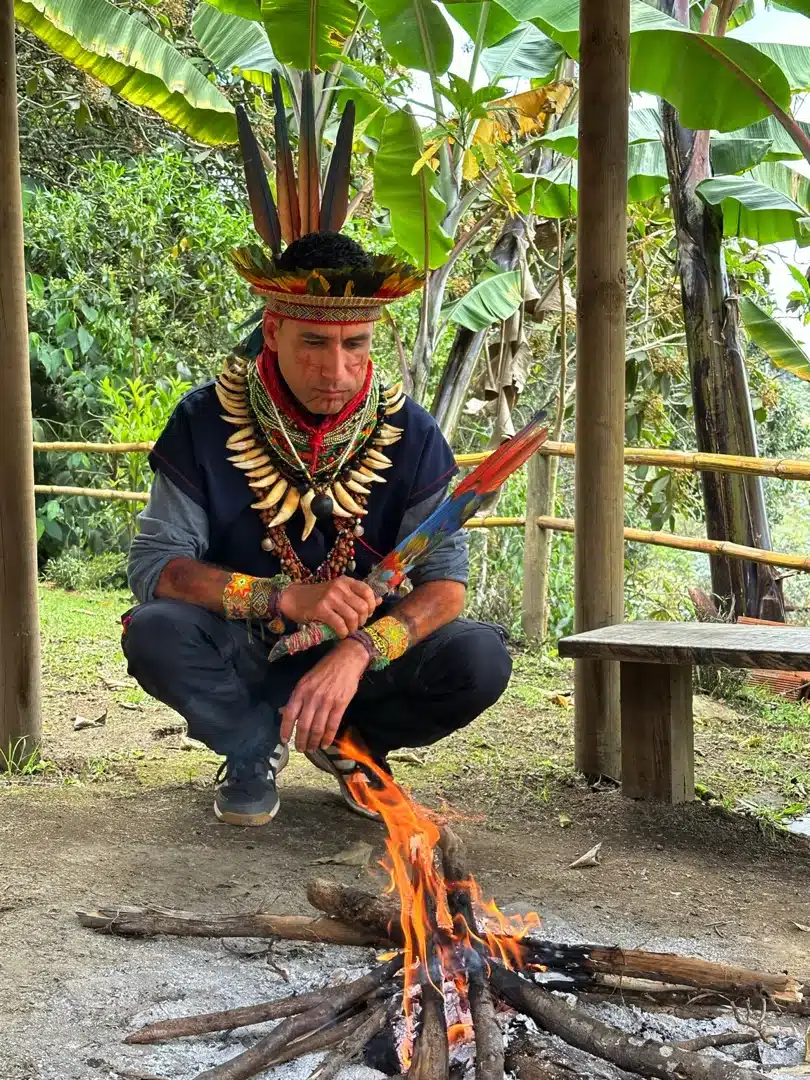
Traditional guidance deserves a different kind of attention from a generic internet symbol dictionary. An experienced Taita may understand yagé through decades of practice, teachings received from elders, ceremonial observation and a cultural context that an online article cannot reproduce. That context matters. But traditional teachings also come from particular lineages. An interpretation given to one person during one ceremony shouldn't automatically become a universal law about what every serpent means. The details of the conversation matter too. A Taita who knows what happened during the ceremony, knows the participant and understands the wider ceremonial process has considerably more context than someone answering "black snake spiritual meaning" on the internet.
This is one reason Colombian yagé traditions shouldn't be flattened into generic "shamanic snake symbolism." The tradition and the relationship around the interpretation matter.
Integration Matters More Than the Symbol
After a powerful serpent vision, the obvious question is: "What did the snake mean?" A more useful question may eventually become: "What did my relationship with the snake show me?" Maybe fear was central. Maybe power. Maybe surrender. Maybe protection. Maybe instinct. Maybe sexuality. Maybe change. Maybe the experience remains mysterious. You don't have to solve every vision. Integration is less about producing the perfect explanation and more about noticing whether an interpretation helps you understand your experience and live differently afterward.
Our guide to ayahuasca integration goes deeper into what happens after ceremony and how insights can be examined once you're back in ordinary life.
Learn More About Ayahuasca Symbols and Visions
Snakes are only one recurring form of ayahuasca imagery. Our main guide to ayahuasca symbols and their possible meanings explores animals, geometric patterns, colors, entities, memories, recurring visions and experiences where no clear imagery appears at all. The same principle runs through both articles: Observation → Interpretation → Integration Notice what happened first. Interpret second. Then see whether that interpretation remains useful.
Colombian Yagé Context
Camino al Sol works within a traditional Colombian yagé context in the mountains of El Retiro, Antioquia, near Medellín. Ceremonial context includes preparation, experienced Taita guidance, medicine music, small groups and integration. Participation also requires health and medication screening before acceptance. If you're researching the tradition rather than a particular vision, start with our guide to yagé in Colombia. If you're considering participating yourself, read our ayahuasca safety standards and our guide to an ayahuasca retreat in Colombia. A powerful snake vision can matter deeply without having one predetermined meaning. Sometimes the most respectful response to a symbol isn't to decode it. It's to keep paying attention.
