
Mario Santacruz Cabrera on Andean instruments and the place of silence in a yagé ceremony.
When an Andean group came to play in the town in Nariño where Mario Santacruz Cabrera grew up, what stayed with him was the lowest sound. Among the flutes, strings, and drums was a toyo, one of the largest Andean panpipes, and its deep note went straight through him. "It was like the memory of a certainty," he says. He wanted to learn to make that sound himself.
By then he already knew some guitar. Lessons cost more than he and his friends could afford, so a self-taught musician offered to show them, and on Mother's Day they went out to play. Mario liked the guitar, but the messages in the boleros and trio music he was learning didn't convince him. He tried rock en español and didn't really connect with that either.
Instruments were hard to come by in his town. Mario remembers the musicians who let him look at theirs, among them his friend Álvaro Moreno, a guitarist, trumpeter, and fine Andean musician. Most of what he learned, he had to decipher by ear. That taught him something about the people who wrote the music he loved. They too had once had something to say, and had kept searching, without giving up, until they found the notes for it. He still pays close attention to musicians who are just starting out, and says their efforts open new windows for him too.
Today Mario plays charango and guitar, quenas in several sizes, panpipes, and percussion. He feels closest to the Andean winds, because a single wind instrument can do so much with nothing else behind it. He also makes instruments. When he was interviewed for this piece, he was painting a turtle on a drum, a requested design full of fine detail. When he wasn't sure what the painting needed next, he would put it down and play, looking for inspiration in the sound.
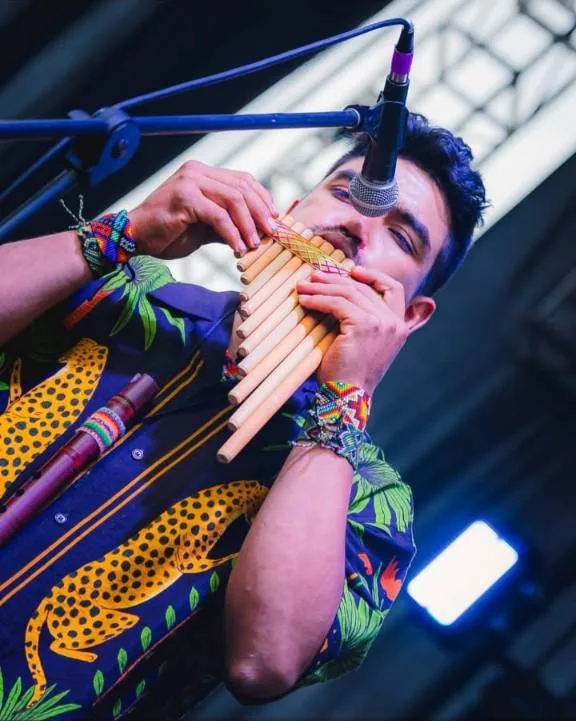
At Camino al Sol, where Mario accompanies yagé ceremonies, having that many instruments within reach raises a practical question. How does he know when to play?
He starts by listening, and the listening begins before the ceremony does. During the mambeo beforehand, when the group goes over the guidelines for the night, he watches the participants. He notices the person who wants to say a lot and the one whose euphoria spills over. He notices the one with downcast eyes who finds it hard to speak, and two people who avoid each other's greeting. Later in the night, one of those faces or moments may come back to him, and he plays with it in mind. If someone across the room seems to be having a hard time, he looks for a sound that might help them through it.
He listens to the taita, too. A taita can see deeply into everyone taking part. Mario thinks of his own role as collaboration: helping the taita hold what he sees in harmony, so that he doesn't feel alone, but supported and accompanied. With the other musicians, it's a shared responsibility. "There's no punishment instrument," Mario says. A talented guitarist may be asked to play the bombo or a maraca at a given moment, and Mario wants musicians to see that this doesn't make them less. That part matters as much as the lead voice.
"Silence is the most important thing," he says. "Silence is what makes everything possible." Hearing has no off switch, he points out, so whatever is played goes straight in. Without enough silence, people can feel overwhelmed, and a musician who doesn't respect the silences can stir up a storm. Sometimes music belongs inside a quiet. After a palabreo, a conversation in which people have been speaking about something sensitive, a silence often falls. A little music there gives the group time to take in what was said while the facilitators prepare what comes next. Other times, Mario leaves the quiet alone.
In a ceremony, he says, a musician isn't there to be seen. That shapes how he responds when people call out requests. He understands the pleasure of wanting to hear a particular song. But the moment may not call for pleasing one person. It may call instead for music that brings the moment into harmony, something the whole group experiences together. Not every moment needs to be fast and euphoric, either. People move through calm and gentler stretches, and the music moves with them.
The musician, Mario adds, takes part much as a patient does, and so does the taita: each has their own process with the medicine. Afterward, if someone asks what a song was about, he's glad to talk, and hopes they'll go home and keep listening to songwriters with something to say.
Music first came to Mario in ceremony on a very hard night. As he tells it, the medicine was teaching him to find his own joy rather than wait for anyone else's, and it left him in a cold silence, unable to find words or even coordinate his hands to drink. He searched for sounds, close to animal calls, until he recognized his own voice and a verse of "Estrellita divina" began to resonate. Someone put a guitar in his hands, and he found his way out through that song. Afterward, the taita told him he might communicate very well in yagé through music.
Some time later, once Mario had begun accompanying ceremonies, the taita he had started with invited him to three days of ceremony around Manizales, one of them at La Gruta, a cold, damp place where the trail up Nevado del Ruiz begins. Mario came back down with a question: he had been singing other people's songs, so what would he sing about? At the time, people were reclaiming the memory of the Quimbaya, and had begun saying that the mountain's true name was Kumanday. At home he started writing. He remembered a time when snow had covered Galeras, or Urkunina, the volcano of his native Nariño, and the song came quietly.
Over the following year he grew bolder about singing it in company, and as people learned it, parts of the song began to change.
One morning he was accompanying the same taita in Riosucio, Caldas, among Emberá communities. He had sung the song several times by then and wasn't looking for anything from it. As day was breaking, he felt like singing it again, and began with his eyes closed. Soon he could hear rattles all around him. When he opened his eyes during the second verse, nearly everyone had risen to their feet and gathered around him. They were dancing. Then they were singing with him, welcoming the dawn.
That morning gave him strength and took away many doubts. He had set out to discover what he might have to say in a song of his own. By the time he looked up, the people around him knew the words.
