
The safest answer is not a fixed number of days. You should not drink ayahuasca while taking SSRIs, and you should not stop or change antidepressant medication just to attend a retreat without medical supervision.
For many SSRIs, medical labeling around MAOI interactions often uses a minimum 14-day gap after stopping before an MAOI is started. Fluoxetine, known by the brand name Prozac, is different because it can stay active in the body much longer; medical labeling commonly uses 5 weeks after stopping fluoxetine before starting an MAOI.
Ayahuasca is not the same as a prescription MAOI, but traditional ayahuasca/yagé contains MAO-A inhibiting beta-carbolines. That is why SSRI history requires careful review before ceremony.
This page is educational and does not replace medical advice. Do not stop or change medication without speaking with a qualified medical professional.
If you are in crisis, experiencing suicidal thoughts, psychosis, chest pain, severe withdrawal, or another urgent medical issue, seek emergency care immediately.
Quick answer: how long should you be off SSRIs before ayahuasca?
A practical screening answer is:
- Do not combine SSRIs and ayahuasca.
- Do not count “days off” until your prescribing clinician has helped you taper or discontinue safely.
- For many SSRIs, at least 14 days after the final dose is commonly used in SSRI-to-MAOI safety guidance.
- For fluoxetine/Prozac, 5 weeks or longer may be needed.
- Some people may need more time because of dose, duration of use, withdrawal symptoms, other medications, mental health history, or medical risk factors.
At Camino al Sol, this is handled through medical screening before acceptance, not through a generic online rule.
Why SSRIs and ayahuasca are a safety concern
SSRIs increase serotonin activity. Ayahuasca/yagé contains compounds that affect serotonin systems and include reversible MAO-A inhibition. When serotonergic medication and MAO-inhibiting substances overlap, the concern is serotonin syndrome, a potentially life-threatening toxicity.
Possible symptoms can include agitation, confusion, tremor, sweating, diarrhea, high temperature, muscle rigidity, high blood pressure, rapid heart rate, clonus, seizures, or loss of consciousness.
This is not something to “test” in ceremony. If there is any uncertainty about medication timing, the safe decision is to pause and complete proper screening.
Taper time and washout time are not the same thing
This is where many people get confused.
Taper time means the period your clinician may use to reduce the medication gradually. This can take days, weeks, or longer depending on the person.
Washout time means the period after the final dose, when the medication and its active effects are clearing enough to reduce interaction risk.
For ayahuasca, both matter. A person may spend weeks tapering and still need a washout period after the final dose. Someone else may be fully off medication but still not be ready because withdrawal symptoms, mood instability, or other risk factors are present.
That is why the question is not only “how long off SSRIs?” It is also “are you medically and psychologically stable enough for ceremony?”
Common SSRIs that require review
SSRIs include medications such as:
- Sertraline / Zoloft
- Fluoxetine / Prozac
- Escitalopram / Lexapro
- Citalopram / Celexa
- Paroxetine / Paxil
- Fluvoxamine / Luvox
Other antidepressants and psychiatric medications also require review, including SNRIs, MAOIs, tricyclic antidepressants, lithium, antipsychotics, stimulants, sleep medication, benzodiazepines, and some supplements.
If you are taking anything daily or recently stopped medication, include it in your application. Do not assume it is irrelevant.
Why fluoxetine/Prozac often needs longer
Fluoxetine is different from many SSRIs because it has a long-lasting active metabolite. This means the medication can continue to matter after the last capsule or tablet.
For that reason, fluoxetine is often treated more cautiously than shorter-acting SSRIs. A 5-week minimum is commonly referenced in MAOI safety guidance, and some cases may require longer depending on dose, duration, metabolism, and clinical history.
Do not reduce this to “I stopped a month ago, so I’m fine.” Bring the exact medication, dose, stop date, and prescribing history into screening.
What to ask your doctor before applying
You can ask your prescribing clinician direct questions such as:
- Is it medically appropriate for me to taper or discontinue this medication?
- What is a safe tapering plan for my medication and dose?
- How long should I wait after my final dose before any MAOI-like exposure?
- Am I at risk of withdrawal, relapse, mania, psychosis, or destabilization if I stop?
- Are there other medications or supplements I take that could interact?
- Would you consider me stable enough for an intense psychedelic ceremony?
Your doctor does not need to endorse ayahuasca to help you think through medication safety. The important part is that medication changes are not improvised.
Camino al Sol’s approach
Camino al Sol is a traditional Colombian yagé retreat in the mountains of Antioquia, near Medellín. We work with small groups, experienced taitas, preparation support, integration support, and screening before acceptance.
For people taking or recently stopping SSRIs, the process begins with the application and screening form. We may ask for:
- Medication name
- Dose
- How long you have been taking it
- Why it was prescribed
- Whether you are tapering, stopped, or still taking it
- Date of final dose, if already stopped
- Other medications or supplements
- Mental health history
- Recent crisis, hospitalization, mania, psychosis, or suicidal thoughts
This is not a judgment. It is basic safety.
When ayahuasca may not be appropriate right now
Ayahuasca may not be appropriate if:
- You are currently taking SSRIs or other contraindicated medication
- You recently stopped medication without medical support
- You are in active withdrawal
- Your mood is unstable
- You are in crisis
- You have recent suicidal thoughts
- You have a history of psychosis or mania that has not been carefully reviewed
- You feel pressured to stop medication quickly to make retreat dates
In those cases, the safer path may be to wait, stabilize, and revisit the question later.
For broader preparation guidance, read our ayahuasca preparation guide and am I ready for ayahuasca?.
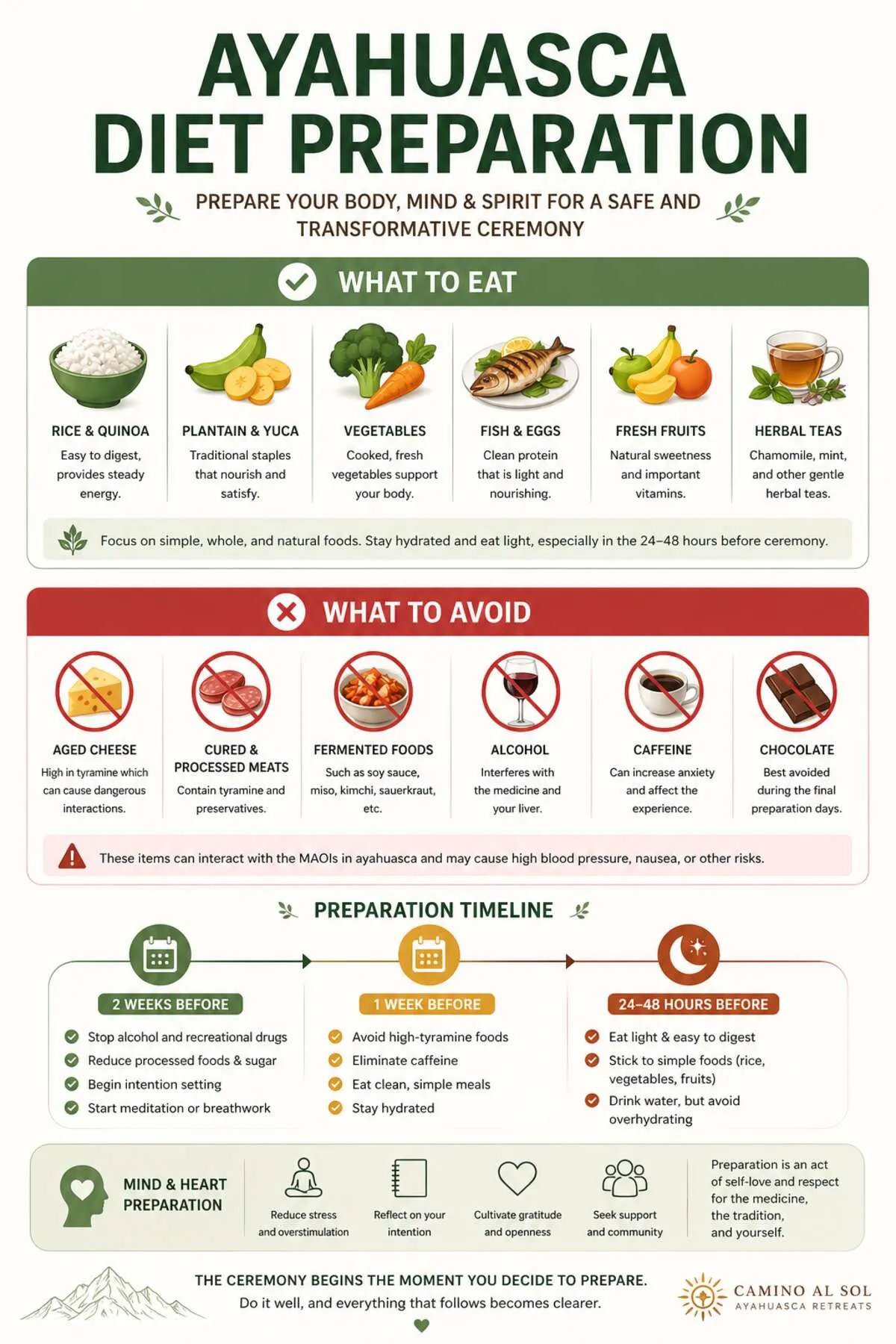
What if you are taking SSRIs for depression, anxiety, or trauma?
Many people interested in ayahuasca are navigating depression, anxiety, grief, trauma, or burnout. That does not automatically mean ayahuasca is right or wrong for you. It means the screening needs to be honest.
Ayahuasca should not be presented as a replacement for medication, therapy, or psychiatric care. It may be meaningful for some people, but it can also be destabilizing if approached at the wrong time or without support.
You may also want to read:
- Best ayahuasca retreat for depression
- Best ayahuasca retreat for anxiety
- Best ayahuasca retreat for trauma healing
- Ayahuasca integration
A safer rule of thumb
If you are asking, “Can I stop my SSRI quickly so I can drink ayahuasca next month?” the answer is: slow down.
A safer approach is:
- Speak with your prescribing clinician.
- Do not stop abruptly unless medically directed.
- Complete tapering safely, if tapering is appropriate.
- Allow an adequate washout period after the final dose.
- Make sure your mood and nervous system are stable.
- Complete retreat screening before booking.
The retreat should fit your health reality. Your health should not be forced to fit retreat dates.
Planning a retreat in Colombia
If you are not currently taking contraindicated medication and want to explore a traditional yagé retreat, you can learn more about our ayahuasca retreat in Medellín or broader ayahuasca retreat in Colombia.
If medication history is part of your question, start with screening rather than booking first.
